Data-Movement-Aware Optimization
of Transformer Attention on Gemmini
ELEC 5140 Final Project
Ivan Lok
May 2026
IBertGemminiRocketConfig · DIM=16 · ACC_ROWS=2048 · WS Dataflow
BERT-base: H=768, 12 heads, D=64 · SEQ_LEN ∈ {128, 256, 512}
1 / 31
What is Gemmini?
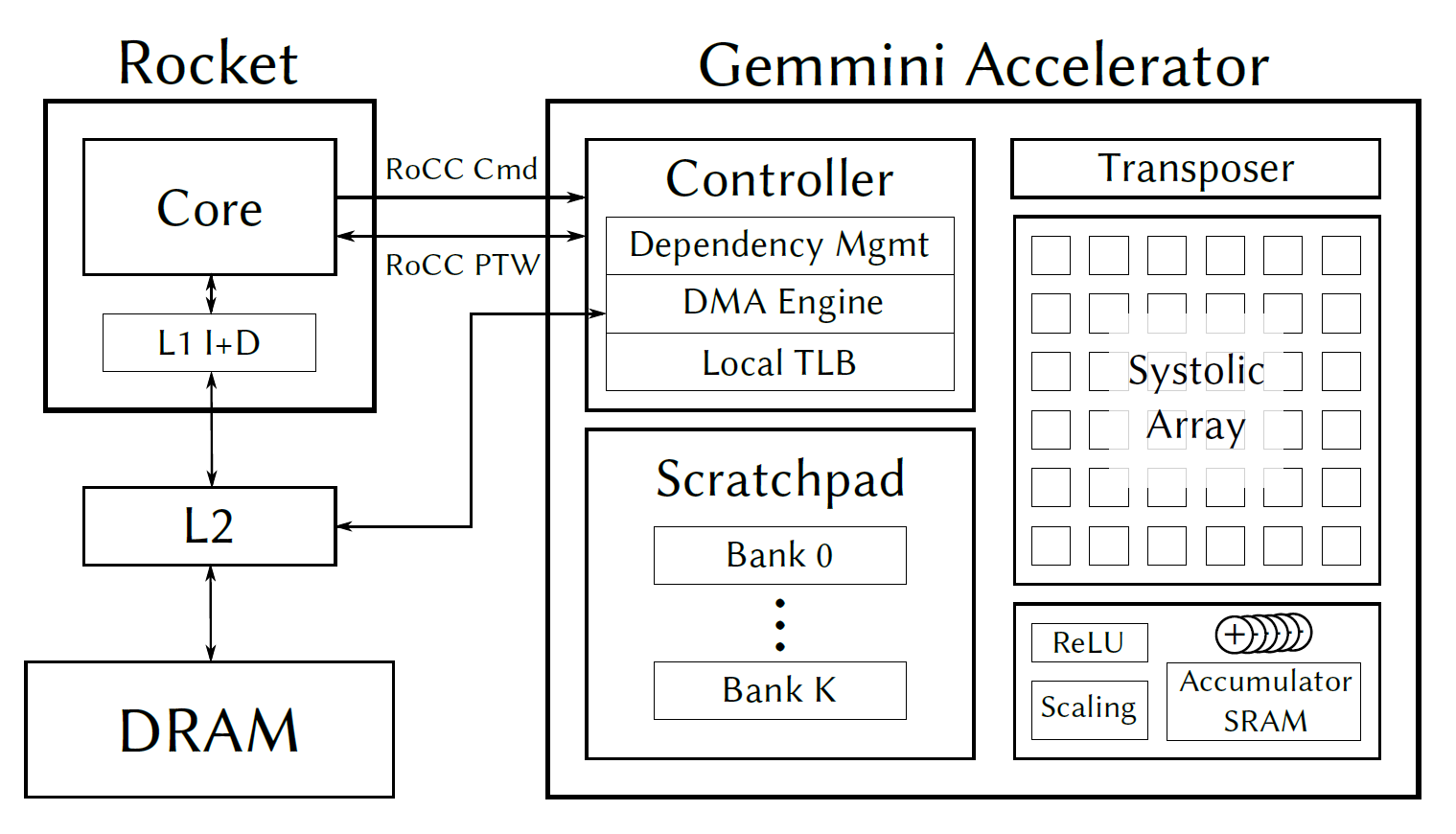
RoCC Accelerator
Rocket issues custom instructions; Gemmini handles tiled matrix operations through its controller.
Scratchpad
On-chip operand SRAM. Matmul A/B operands must be staged here before the systolic array consumes them.
Accumulator
Matmul outputs land here as wider partial sums, then can be scaled, activated, normalized, or moved out.
Systolic Array
16×16 weight-stationary mesh in this project config; this is where QK and PV compute runs.
Attention gap: QK puts scores in the accumulator. PV needs weights in the scratchpad. There's no direct path between them.
2 / 31
Gemmini Constraints That Shape Attention
1. Two On-Chip Memories
Scratchpad feeds operands into the systolic array.
Accumulator receives QK/PV matmul results and supports scale / normalization.
2. Accumulator Is Double-Buffered
With ACC_ROWS=2048, each WS buffer half has 1024 usable rows.
3. Built-In SOFTMAX Is Full-Row
The denominator needs the whole row, so the standard softmax path cannot freely stream partial K-blocks.
Attention Tensors Stress Different Memories
| Tensor | Shape per head | Where it naturally lives | Why it matters |
|---|
| Q per head | SEQ × 64 | Scratchpad input | Left operand for QKT |
| K per head | SEQ × 64 | Scratchpad input | Right operand for QKT |
| V per head | SEQ × 64 | Scratchpad input | Right operand for PV |
| QK scores | SEQ × SEQ | Accumulator | Produced by systolic Q × KT |
| Softmax weights | SEQ × SEQ | Scratchpad for PV | Consumed as PV's A operand |
| PV output | SEQ × 64 | Accumulator / DRAM | Final per-head output |
QK writes into the accumulator; PV wants weights in the scratchpad.
3 / 31
Baseline Gemmini Attention Workflow
Where the attention matrix leaves and re-enters the chip
Stage
Data Movement
Why It Matters
1. Q/K/V projections
Standard tiled matmuls produce the per-head inputs.
DRAM→
SP→
Systolic→
ACC→
DRAM
Normal input/output traffic.
seq=128: 960K cycles
2. QKT + softmax
Scores are produced and normalized on chip.
Q,K in SP→
QKT→
Softmax→
mvout A
A is temporary, but baseline writes it to DRAM.
First half of round trip
3. PV matmul
PV immediately consumes the same A matrix.
DRAM A→
mvin to SP→
PV→
Output
A returns from DRAM just after it was written.
Second half of round trip
4. Wo + LayerNorm
Rest of the Transformer block.
Not the first target in this project.
seq=128: 497K cycles
QK^T puts scores in the accumulator. PV needs weights in the scratchpad. The attention matrix shuttles through DRAM for no reason.
4 / 31
The Problem: An O(seq²) Intermediate Tensor
Attention Core
Scores: S = Q × KT
Weights: A = softmax(S)
Output: O = A × V
For BERT-base: 12 heads, so the attention matrix cost grows with 12 × SEQ².
The Bottleneck
Attention matrix A is an intermediate tensor:
- Produced by QKT + softmax
- Consumed immediately by PV
- Baseline still sends it through DRAM
QK^T →
Softmax →
DRAM write →
DRAM read →
PV
| Seq | Attention Matrix | Wasted DRAM |
|---|
| 128 | 12 × 128² = 196K | 393 KB |
| 256 | 12 × 256² = 786K | 1.57 MB |
| 512 | 12 × 512² = 3.1M | 6.3 MB |
This traffic grows with O(seq²), exactly like the attention matrix itself.
So: can we keep the attention matrix on-chip and skip DRAM entirely?
5 / 31
Experiment 1: Bypass the DRAM Round-Trip
The Core Insight
The first attempt keeps the attention weights inside Gemmini:
Q × K^T →
SOFTMAX →
A (weights) →
A × V
QK and softmax still run as Gemmini steps; only the destination changes.
Experiment 1.2: Data-Movement Fusion
Hardware: route softmax mvout output directly into scratchpad.
Software: write with GEMMINI_LOCAL_STORE_FLAG; run PV with A=NULL.
Dataflow Transformation
Baseline (2 DRAM transfers):
QK^T →
Softmax →
mvout→DRAM →
mvin→SP →
PV
Fused (0 DRAM transfers):
QK^T →
Softmax →
local store→SP →
PV (A=NULL)
Hardware Change
- Detect
GEMMINI_LOCAL_STORE_FLAG
- Route acc/softmax output to scratchpad
- Bypass the normal DRAM writer
Result at seq=128: attention core 611K → 358K; full pipeline 2.15M → 1.88M.
6 / 31
Experiment 1 Result: Good Idea, Bad Scaling
| Seq Len | Baseline Attention | Exp 1 Attention | Speedup | Full Pipeline | Status |
|---|
| 128 |
611,290 |
357,667 |
1.71× faster |
1.88M (vs 2.15M) |
WIN |
| 256 |
1,037,836 |
6,680,878 |
6.4× slower |
~9.54M (vs 3.97M) |
LOSE |
| 512 |
2,623,055 |
CRASH @ 204M cycles — TL assertion |
CRASH |
Why 128 Wins
DRAM round-trip cost (786 KB DMA) > local store overhead (~50K cycles for 3,072 mvout).
Attention: −41% · Full: −12.4%
Why 256/512 Fails
Both J-tile count (SOFTMAX constraint) and Q-block count (Q_BLOCK=16) grow linearly with seq_len. They multiply.
mvout: 3,072 → 12,288 → 49,152
O(seq) × O(seq) = O(seq²) mvout storm
Interpretation: the local-store bypass successfully removes attention-matrix DRAM traffic. The failure is not the bypass idea; it is the combination of small Q-blocks and full-row Accumulator softmax.
7 / 31
Exp 1 at Scale: Slow, Then Crash
seq=256: Death by 147,456 Commands
6.68M
Baseline: 1.04M
6.4× slower in attention core
QK+PV compute is only ~1.47M.
The rest is dispatch overhead.
seq=512: 589,824 Commands = Crash
Crash @ 204M
TileLink assertion
Local-store path overstressed
The bypass is correct, but the control path
can't handle 590K fine-grained writes.
| seq=128 | seq=256 | seq=512 |
|---|
| mvout/head | 3,072 | 12,288 | 49,152 |
| mvout total (12 heads) | 36,864 | 147,456 | 589,824 |
| Result | 1.71× faster | 6.4× slower | Crash |
Same root cause: Q_BLOCK=16 + full-row softmax = O(seq²) mvout commands. No amount of tuning fixes the algorithmic scaling.
8 / 31
Experiment 1.2: What Changed in Software
Step 1: QK^T + SOFTMAX → Scratchpad
tiled_matmul(q_block, SEQ_LEN, HEAD_DIM,
    Q, K, NULL,
    (void*)(uintptr_t)GEMMINI_LOCAL_STORE_FLAG,
    // C is a local-store flag, not a DRAM address
    HIDDEN_DIM, HIDDEN_DIM, 0, SEQ_LEN,
    MVIN_SCALE_IDENTITY, MVIN_SCALE_IDENTITY, MVIN_SCALE_IDENTITY,
    SOFTMAX, ACC_SCALE_IDENTITY, 0,
    false,
    1, SEQ_LEN / DIM, QK_TILE_K,  // tile_J = full seq
    false, false, true,
    false, 0, WS);
gemmini_fence();
// Softmax output now lands in scratchpad
// No attention buffer is written to DRAM
Step 2: PV with A=NULL (SP weights)
tiled_matmul(q_block, HEAD_DIM, SEQ_LEN,
    NULL, V, NULL, O,    // A=NULL: use existing SP weights
    SEQ_LEN, HIDDEN_DIM, 0, HIDDEN_DIM,
    MVIN_SCALE_IDENTITY, MVIN_SCALE_IDENTITY, MVIN_SCALE_IDENTITY,
    NO_ACTIVATION, ACC_SCALE_IDENTITY, 0,
    false,
    1, PV_TILE_J, PV_TILE_K,
    false, false, false,
    false, 0, WS);
gemmini_fence();
// PV skips mvin of A; only final O is written out
Baseline vs Fused
| Baseline | Fused (Exp 1.2) |
|---|
| QK^T output dest | C = attn_buf (DRAM addr) | C = (void*)GEMMINI_LOCAL_STORE_FLAG |
| Softmax mvout goes to | DRAM (via DMA Writer) | Scratchpad SRAM (via local store wire) |
| PV A operand | DRAM (via mvin: attn_buf→SP) | Scratchpad (A=NULL, already there) |
| Attn matrix in DRAM | 12 × 128² = 196 KB | 0 — never leaves chip |
9 / 31
Why the First Bypass Does Not Scale
Constraint 1: Built-In SOFTMAX Needs Full Rows
Why? Softmax is row-wise:
softmax(xᵢ) = exp(xᵢ) / Σⱼ exp(xⱼ)
The denominator needs all elements in the row. Partial J tiles do not have enough information.
tile_J = SEQ_LEN / DIM for built-in softmax.
What this means for Exp 1
The local-store bypass changes where softmax output goes, but not how the built-in softmax path is driven.
Softmax output
→
Baseline: DRAM
Softmax output
→
Exp 1: Scratchpad
| Good | Bad |
|---|
| Avoids DRAM round-trip | Still many store commands |
| PV can use A=NULL | Still full-row softmax |
10 / 31
How the Accumulator Does Softmax
Context: After QKT matmul, the accumulator holds scores in int32. Built-in SOFTMAX runs inside the accumulator when data is read out via mvout — processing one row at a time, horizontally across columns.
One Row in the Accumulator (SEQ_LEN columns, int32)
J-tile 0
cols 0..15
→
J-tile 1
cols 16..31
→
J-tile 2
cols 32..47
→
···
→
J-tile N-1
last 16 cols
N = SEQ_LEN / DIM = SEQ_LEN / 16 | Each J-tile = 16 columns processed in parallel by the accumulator lanes
3-Pass Horizontal Scan (per row)
| 1 | Find max | Scan all J-tiles left→right, track max value |
| 2 | Exp + Sum | Re-scan: exp(x − max) per element, accumulate Σ |
| 3 | Normalize | Re-scan: exp / Σ → scale → write out as int8 weights |
Three passes because the accumulator needs the full-row max before exp, and the full-row sum before normalize.
Why Full Row Is Non-Negotiable
softmax(xᵢ) = exp(xᵢ − max) / Σⱼ exp(xⱼ − max)
The denominator Σⱼ couples every column in the row. You cannot normalize J-tile 0 until you have scanned ALL J-tiles to compute the global sum.
Result: each mvout must process the entire row — 3 passes × N J-tiles — before any weight is written out.
Horizontally: softmax is a reduction (max, sum) across all columns, then element-wise normalize. The accumulator must traverse the entire row. Vertically: rows are independent — which is why Q_BLOCK lets us batch rows together. But horizontal dependency is the bottleneck that online softmax later fixes.
11 / 31
Constraint 2 in Detail: Q_BLOCK=16 Repeats the Full-Row Store
What happens after each QKT tile?
Exp 1 computes only 16 query rows at a time:
Q_BLOCK = DIM = 16
scores tile = 16 rows × SEQ_LEN columns
After that tile finishes, the built-in SOFTMAX/local-store path still has to emit the normalized attention weights for those 16 rows across the entire J dimension.
Important: Q_BLOCK=16 is not the thing that creates mvout. The softmax output path creates the mvout-style store. Q_BLOCK=16 makes us repeat that store loop many times.
The loop that explodes
For each Q-block:
  QK^T produces 16 × SEQ_LEN scores

  For each row in the Q-block:        // 16 rows
    For each softmax/store pass:      // 3 passes
      For each J-block:               // SEQ_LEN / 16
        gemmini_extended_mvout(...)

mvout per Q-block = 16 × 3 × (SEQ_LEN / 16)
                  = 48 × (SEQ_LEN / 16)
| Seq | Q-blocks/head | mvout/Q-block | mvout/head |
|---|
| 128 | 8 | 384 | 3,072 |
| 256 | 16 | 768 | 12,288 |
| 512 | 32 | 1,536 | 49,152 |
The repeated full-row store is the problem. The bypass removes DRAM traffic, but the CPU still drives thousands of small RoCC store operations.
12 / 31
The Transition: Why We Can't Make J Smaller
Full-Row Softmax
softmax(xᵢ) = exp(xᵢ − max) / Σⱼ exp(xⱼ − max)
The denominator Σⱼ couples all K/J positions in the row.
Result: built-in softmax wants full-row processing.
Online Softmax
Keep running state per row:
m = running max
s = running sum
Each J-tile updates the state, so columns stream tile-by-tile (16 at a time).
Goal: stop materializing and re-driving the full attention row through many small commands.
13 / 31
Experiment 2: The Intuitive Way
Intuitive Way
- The Accumulator already computes softmax
- It already has exp / scale hardware
- So add more Accumulator commands for online softmax
What We Tried
- Add online update / commit commands
- Reuse Accumulator state IDs for running max / sum
- Reuse the mvout-style path to write weights
This proved the idea: online softmax can be implemented in Gemmini hardware. But it also exposed why modifying the Accumulator is not a clean final design.
14 / 31
Before Experiment 2: Accumulator Control Path
Key point: the Accumulator is driven by existing mvout/config command fields. It is not a standalone attention engine.
1. Software Issues Commands
gemmini_extended_mvout(...)
gemmini_config_norm(..., stat_id)
functRoCC op
rs1src ptr
rs2dst addr
configscale / stat_id
→
2. Address / Config Decode
addr[24:0]row / offset
addr[27:25]NormCmd, 3 bits
addr[... ]flags / width
stat_id0 or 1
scale argsaccumulator config
→
3. Accumulator Pipeline
| Input | Accumulator row |
| State slots | NORM_STAT_IDS=2 |
| Compute | max → exp → sum → scale |
| Width | DIM=16 lanes |
What Experiment 2 would have to overload
Command Field
Original: 8 commands = 3 bits
Online: 13 commands = 4 bits
+
State Field
stat_id=0/1: existing Accumulator state slots
Experiment 2 tried to reuse one slot for online max / sum
+
Output Path
mvout to DRAM
Exp 1 local-store branch to scratchpad
So the Accumulator approach touches three shared mechanisms at once: command decode, state selection, and the existing output dataflow.
15 / 31
Why Not Keep Adding Accumulator Commands?
Problem 1: Command Encoding
Original NormCmd: 8 commands = 3 bits.
Add online softmax: +5 commands → 13 commands = 4 bits.
NormCmd packed into mvout addresses makes NORM_CMD_SHIFT fragile. If SW and RTL disagree, existing SOFTMAX / LayerNorm decoding can break.
Problem 2: State ID
Accumulator config: NORM_STAT_IDS=2.
Online softmax plan: reserve stat_id=1 for running max / sum; use stat_id=0 for default PV / mvin.
One wrong config can overwrite the online state mid-attention.
Problem 3: Fixed DIM vs Head Dimension
The Accumulator works at DIM=16 lanes. But each attention head has HEAD_DIM=64, so O-rescale becomes 4 commands per row.
Problem 4: Existing Dataflow
To make this work, we keep touching shared Accumulator / mvout / scratchpad behavior. That can change existing SOFTMAX, LayerNorm, residual, and scaling behavior.
Given that: we decided to design a dedicated OnlineAttention hardware module instead of overloading the Accumulator.
16 / 31
Two Tiling Dimensions: What Exp 1 Broke (and What We Fixed)
J-Tiling — The Real Bottleneck Exp 1 kills
QKT output is [Q_rows × SEQ_LEN]. Hardware grid is DIM=16, so J is split into SEQ_LEN/DIM tiles of 16 columns:
seq=256 → 256 cols = 16 J-tiles of col0..15, col16..31, ..., col240..255
Built-in SOFTMAX needs all J at once for the denominator. Each J-tile → 1 mvout command. With Q_BLOCK=16:
16 rows × 3 passes × 16 J-tiles = 768 mvout per Q-block
K-Tiling — Separate Concern Future
Splitting K means incomplete rows — the softmax denominator is partial. Built-in SOFTMAX can't handle this at all.
Online softmax can handle K-splitting via running max/sum + rescale, but for seq ≤ 512 we never need it:
K_BLOCK = SEQ_LEN (single-pass)
K-tiling matters for seq ≥ 1024 — future work.
What Online Softmax Actually Fixes (for Us)
Exp 1 failed because J-tiling × small Q_BLOCK = O(seq²) RoCC dispatch. OnlineAttention's BATCH_WEIGHTS streams all J-tiles internally with running max/sum — one RoCC call per Q-block regardless of seq_len. K_BLOCK = SEQ_LEN eliminates K-tiling entirely (single pass).
17 / 31
Online Softmax: Streaming Across J-Tiles
Even with K_BLOCK=SEQ_LEN, hardware processes only DIM=16 columns at a time. Online softmax streams J-tiles with running stats:
m = running max
s = running sum
New J-tile arrives (16 columns at a time):
Check if max increased. If yes → rescale old sum before adding new terms.
Example: 3 J-tiles, one row (12-element row, DIM=4 for simplicity)
| Step | Scores (4 cols) | m | s |
|---|
| Init | — | −∞ | 0 |
| J-tile 1 | [3, 1, 4, 1] | 4 | Σexp(s−4) |
| J-tile 2 | [7, 2, 1, 3] | 7 | s×exp(4−7) + Σexp(s−7) |
| max ↑ | old sum rescaled by exp(old_max − new_max) |
| J-tile 3 | [2, 5, 1, 2] | 7 | s + Σexp(s−7) |
| max = | no rescale — just add new exp terms |
After all J-tiles: weight = exp(score − m) / s. BATCH_WEIGHTS does this for all rows + all J-tiles in one RoCC command.
18 / 31
Gemmini Reality: INT Scores, INT Weights
| Design choice | Why |
|---|
| Scores are int32 |
Systolic array outputs int32. QKT scores land directly — no FP conversion. |
| Weights are int8 |
Scratchpad stores int8. PV reads A=inputType=int8. Output must fit in [0, 127]. |
| No FP math library |
Baremetal C on RISC-V. No expf(). Hardware computes exp() in fixed-point combinational logic. |
| Scale before iexp |
ONLINE_BERT_SCALE=0.05 compresses scores so fixed-point exp doesn't saturate. |
| Saturation = zero weight |
z ≥ 32 → iexp(z) = 0. Very negative → ~0. Correct softmax behavior. |
Not FP32:
Papers assume FP32. In hardware, number formats come from the datapath.
Every op — multiply, max, exp, sum, normalize — is fixed-point int32.
19 / 31
Hardware exp() Without Floating Point
Computes 2ax² + bx + c — second-order polynomial approximation of exp():
One iexp unit: x (int32) → ax² + bx + c → 2result (int32)
| Config register | Purpose | Set via |
|---|
iexp_qln2_reg | ln(2) in fixed-point | gemmini_oa_config(0, ...) |
iexp_qln2_inv_reg | 1/ln(2) for base conversion | gemmini_oa_config(1, ...) |
iexp_qb_reg | Coefficient b | gemmini_oa_config(2, ...) |
iexp_qc_reg | Coefficient c | gemmini_oa_config(3, ...) |
Key design choices:
16 parallel units — one per DIM lane. One cycle per chunk.
Reuses AccumulatorScale.iexp() — already validated for Gemmini softmax.
z ≥ 32 → output 0 — hardware saturation = near-zero weight.
Runtime configurable — tune coefficients without rebuilding Verilator.
The only compute in OnlineAttention. Everything else is state management and data movement.
20 / 31
OnlineAttention: What the Hardware Actually Does
OnlineAttention.scala — ~700 lines of Chisel. One module, one RoCC function (funct=23), one 7-state FSM. Lives between accumulator and scratchpad.
INPUT
Accumulator
QKT scores
int32 matrix
up to 128×512
→
COMPUTE (7-state FSM)
| ① | Read 16 int32 scores from accumulator |
| ② | 16-way max reduction → chunk_max |
| ③ | Update running max / sum (rescale if max increased) |
| ④ | Re-read scores, 16 × iexp(score − max) in parallel |
| ⑤ | Clamp to [0,127], pack 16 × int8 |
→
OUTPUT
Scratchpad
int8 softmax weights
Ready for PV matmul
A=NULL
Phase 1 — UPDATE (track max & sum)
Streams J-tiles (16 columns at a time). Per row: tracks running max m and sum s. When max increases, rescales old sum by exp(old_max − new_max). No full-row wait — columns arrive tile-by-tile.
Phase 2 — WEIGHTS (write to scratchpad)
Re-reads same scores. Subtracts final max. 16 parallel iexp units. Clamps to [0,127], packs 16×int8, writes to scratchpad. One cycle per 16-element chunk.
Why re-read? Score matrix up to 512 KB — too big to buffer. Re-reading is free: accumulator is idle during gemmini_fence(). |
State: 3 KB registers (128 rows × 3 × int32) |
iexp: 16 parallel combinational units, reuses AccumulatorScale.iexp()
21 / 31
Online Softmax in Action: One Row, Three Chunks
Concrete example: one Q row, 48 K positions streamed as three 16-element chunks. Two numbers of state per row.
Running max
m
starts at −∞
Running sum
s
starts at 0
| Chunk | 16 scores (conceptual) | chunk_max | m update | s update |
|---|
| 1 |
[3, 1, 4, 1, ..., 9, 7, 9, 3] |
9 |
−∞ → 9 |
s = Σ exp(score − 9)
(first chunk, compute normally) |
| 2 |
[2, 11, 1, 8, ..., 9, 2, 6, 5] |
11 |
9 → 11 |
s = s_old × exp(9−11) + Σ exp(score − 11)
(max increased: rescale old sum first!) |
| 3 |
[3, 5, 8, 10, 7, 9, 3, ..., 6, 4, 3] |
10 |
11 (no change) |
s += Σ exp(score − 11)
(max unchanged: just add new terms) |
Final: all chunks done.
Weights = iexp(score − 11) / s_final, clamped to [0,127] int8, written to scratchpad.
(Division folded into PV matmul or post-pass rescale)
Why this works: exp(a−m) / Σexp(...) = exp(a−m') / Σexp(...) when rescaling by exp(m−m'). The softmax value for each element doesn't change — only the running denominator gets corrected.
INT reality: We use fixed-point iexp (2ax²+bx+c). Scores are int32 from systolic array. Weights are int8 for scratchpad. No floating point anywhere.
22 / 31
Side by Side: Baseline vs Experiment 4
Both do the same math — QKT + softmax + PV. The difference is where data lives.
Baseline Gemmini Attention
// Step 1: QK^T → DRAM (via C pointer)
tiled_matmul_auto(SEQ_LEN, SEQ_LEN, HEAD_DIM,
A, B, NULL, C=attn_buf, // → DRAM
HIDDEN_DIM, HIDDEN_DIM, 0, SEQ_LEN,
..., SOFTMAX, ACC_SCALE_IDENTITY, 0, ...);
gemmini_fence();
// Step 2: PV (weights from DRAM)
tiled_matmul_auto(SEQ_LEN, HEAD_DIM, SEQ_LEN,
A=attn_buf, B=V_buf, NULL, C=out_buf,
SEQ_LEN, HIDDEN_DIM, 0, HEAD_DIM,
..., NO_ACTIVATION, ...);
gemmini_fence();
✗ Attention matrix A written to DRAM, then read back
Experiment 4 (OnlineAttention)
// Step 1: QK^T → accumulator (scores stay on chip)
gemmini_loop_ws(I, J, K, 0, 0, 0,
Q_ptr, K_ptr, NULL, NULL, // no DRAM out
..., ex_accumulate=true, ...);
gemmini_fence();
// Step 2: Online softmax acc → scratchpad
gemmini_oa_fused_batch(
Q_BLOCK, SEQ_LEN,
sp_weights_base, acc_addr);
gemmini_fence();
// Step 3: PV (weights from scratchpad)
gemmini_loop_ws(I, J, K, 0, 0, 0,
NULL, V_ptr, NULL, O_ptr, // A=NULL=SP
..., ex_accumulate=true, ...);
gemmini_fence();
✓ Attention matrix stays on chip: accumulator → scratchpad directly
What disappeared: attn_buf[heads][SEQ][SEQ] — the O(N²) DRAM buffer. No SOFTMAX activation flag. No separate weight MVIN/MVOUT.
What appeared: gemmini_oa_fused_batch() — one RoCC command. A=NULL in PV tells hardware to read weights from scratchpad. Scores live in accumulator between QKT and softmax.
23 / 31
Where the Bytes Go: Data Movement Comparison
Baseline — DRAM Round-Trip
① QKT → acc → DRAM (mvout scores)
② DRAM → acc (mvin scores)
③ SOFTMAX acc → DRAM (mvout weights)
④ DRAM → sp (mvin weights)
⑤ PV → DRAM (output)
2 DRAM round-trips for O(N²) attention matrix
Experiment 4 — On-Chip Only
① QKT → Accumulator (on-chip)
② Acc → OnlineAttn HW → Scratchpad
③ SP weights → PV (A=NULL)
0 DRAM transfers for attention matrix
Baseline memory footprint (per head, seq=512)
attn_buf
512×512 int8
256 KB DRAM
Experiment 4 memory footprint (per head, seq=512)
Accumulator
int32 scores
on-chip
→
Scratchpad
int8 weights
on-chip
seq=512, 12 heads:
Baseline ~6.3 MB DRAM for A matrix vs
Exp 4 0 MB
Data-movement fusion, not compute fusion. QKT, softmax, PV still separate ops — we eliminated the DRAM intermediaries. Only Q, K, V, O (all O(N)) touch DRAM.
24 / 31
End-to-End: 3 Commands Per Head
1. QKT matmul
→
2. OP_FUSED_BATCH
→
3. PV matmul
Attention matrix never touches DRAM. Scores stay in accumulator. Weights go accumulator → scratchpad directly.
Experiment 5 — Clean Measurement (config outside timing, zero printf)
Full pipeline results
| Seq | Q_BLOCK | QKV | Attention | Wo | Norm | Total |
|---|
| 128 | 128 | 913K | 245K | 309K | 164K | 1,631K |
| 256 | 256 | 1,804K | 486K | 609K | 369K | 3,269K |
| 512 | 128 | 3,582K | 1,882K | 1,204K | 759K | 7,427K |
seq=128: QKV 56%, Attn 15%, Wo 19%, Norm 10%
seq=512: QKV 48%, Attn 25%, Wo 16%, Norm 10%
Attention grows from 15% to 25% of total — O(N²) in action.
25 / 31
Optimization Journey: 30.2M → 1.63M (18.5× Improvement)
Six key phases. Each attack a different bottleneck. All numbers at seq=128 for fair comparison.
| Phase | What Changed | Total | vs Baseline |
|---|
| Baseline |
Official Gemmini: QK^T + SOFTMAX + PV, attn matrix through DRAM |
2,149K | 1.00× |
| Exp 1.2 |
Local-store fusion. Q_BLOCK=16. No online softmax. Works at 128, fails at scale |
1,882K | 1.14× |
| 4G→4H |
Per-row ops → batch ops. 242→9 RoCC/K-block (16× reduction). First integrated pipeline |
30,244K→15,353K | 0.07→0.14× |
| 4I |
K_BLOCK=128 (single-pass). Eliminate K-block loop + RESCALE. Online softmax proves correct |
6,995K | 0.31× |
| 4L→4M |
Q_BLOCK=128. Single Q-block per head. Remove CPU from critical path. DRAM internal MVIN |
3,103K→1,793K | 0.69→1.20× |
| Exp 5 |
Optimal Q_BLOCK (sweep-verified per seq). OP_FUSED_BATCH. Clean measurement (zero printf) |
1,631K | 1.32× |
Three biggest leaps:
1. Per-row → batch ops: 16× RoCC reduction (4G→4H)
2. K_BLOCK=128: no K-loop, no RESCALE (4H→4I)
3. Q_BLOCK=128 + CPU removal: 8× fewer matmuls (4I→4M)
Exp 5 pipeline (seq=128):
QK^T →
OP_FUSED_BATCH →
PV (A=NULL)
3 RoCC commands per head. Zero CPU extraction. Zero DRAM for attn matrix.
26 / 31
What is Q_BLOCK — and Why It Matters
QKT produces a [seq_len × seq_len] score matrix. Q_BLOCK = how many Q rows we process per batch.
Q [seq×64] × KT [64×seq] = Scores [seq×seq]
↑ Q_BLOCK rows per batch ↑
Each Q-block does: QK^T → online softmax → PV. More Q-blocks = more RoCC commands = more dispatch overhead.
Why only sweep Q_BLOCK? Online softmax handles K streaming — K_BLOCK = SEQ_LEN always. Only Q_BLOCK is a free variable.
| Q_BLOCK | Q-blocks @ seq=256 | RoCC cmds/head | ACC tiles needed |
|---|
| 16 | 16 | 48 | 4 |
| 64 | 4 | 12 | 16 |
| 128 | 2 | 6 | 32 |
| 256 | 1 | 3 | 64 (full half) |
Small Q_BLOCK (e.g. 16)
Scores fit easily in ACC (4 tiles). But many RoCC commands — each with dispatch overhead. Exp 1: Q_BLOCK=16 → 384 matmuls at seq=256 → 6.4× slower.
Large Q_BLOCK (e.g. 256)
Few RoCC commands (3/head). But ACC overflow: scores exceed one ACC half → DMA spill to DRAM. At seq=512: 8× overflow → tipping point.
The trade-off: RoCC dispatch overhead (small Q_BLOCK) vs ACC overflow DMA (large Q_BLOCK). Optimal Q_BLOCK depends on seq_len and ACC capacity.
27 / 31
Q_BLOCK Sweep: Finding the Optimal per Sequence Length
Experiment 5 sweeps Q_BLOCK at each seq_len. Clean measurement — zero printf, config outside timing. K_BLOCK = SEQ_LEN always.
| seq=128 (K_BLOCK=128) |
|---|
| Q_BLOCK | Q-blocks | Attention | vs Best |
|---|
| 16 | 8 | 432K | +79% |
| 64 | 2 | 262K | +7.5% |
| 128 | 1 | 244K | — |
| seq=256 (K_BLOCK=256) |
|---|
| Q_BLOCK | Q-blocks | Attention | vs Best |
|---|
| 16 | 16 | 1,338K | +175% |
| 128 | 2 | 512K | +5.4% |
| 256 ★ | 1 | 486K | — |
| seq=512 (K_BLOCK=512) |
|---|
| Q_BLOCK | Q-blocks | Attention | vs Best |
|---|
| 16 | 32 | 3,492K | +92% |
| 128 | 4 | 1,825K | — |
| 256 | 2 | 1,883K | +3.2% |
U-curve confirmed: Q_BLOCK too small → dispatch overhead dominates. Q_BLOCK too large → ACC overflow DMA dominates.
seq=256: Q=256 optimal (not 128!). onlineAttentionMaxRows=256 enables single Q-block without sub-block splitting.
seq=512: Q=256 hits tipping point — 8× ACC overflow DMA exceeds dispatch savings. Q=128 remains optimal.
Why can't we go further?
ACC half = 1024 rows × DIM col = 64 tiles (WS double-buffering).
Q=256, K=512 → 512 tiles → 8× overflow
Q=512, K=512 → 1024 tiles → 16× overflow
maxrows upgrade alone isn't enough. Need larger ACC (e.g. ACC_ROWS=4096) to unlock Q_BLOCK=256 at seq=512.
28 / 31
Final Results: Baseline vs Exp 1 vs Exp 5
Experiment 5 — clean measurement (zero printf, config outside timing, OP_FUSED_BATCH). Optimal Q_BLOCK per seq_len.
| Seq | Experiment | QKV | Attention | Wo | Norm | Total | vs Baseline |
|---|
| 128 | Baseline | 960K | 611K | 309K | 188K | 2,149K | 1.00× |
| 128 | Exp 1 (local store) | 962K | 358K | 309K | 176K | 1,882K | 1.14× |
| 128 | Exp 5 | 913K | 245K | 309K | 164K | 1,631K | 1.32× |
|
| 256 | Baseline | 1,851K | 1,038K | 610K | 395K | 3,973K | 1.00× |
| 256 | Exp 1 (local store) | ~1,851K | 6,681K | ~610K | ~395K | ~9,536K | 0.42× |
| 256 | Exp 5 | 1,804K | 486K | 609K | 369K | 3,269K | 1.22× |
|
| 512 | Baseline | 3,629K | 2,623K | 1,204K | 801K | 8,336K | 1.00× |
| 512 | Exp 1 (local store) | CRASH @ 204M cycles — TL assertion |
| 512 | Exp 5 | 3,582K | 1,882K | 1,204K | 759K | 7,427K | 1.12× |
Scaling (vs self @ seq=128)
| 128→256 | 256→512 |
|---|
| Baseline | 1.85× | 2.10× |
| Exp 1 | 5.07× | CRASH |
| Exp 5 | 2.00× | 2.27× |
Exp 5 wins at ALL sequence lengths.
Scaling is clean O(N) — pure hardware with matmul dimensions.
Works at seq=512 where Exp 1 crashes.
Attention matrix never touches DRAM (0 bytes vs up to 6.3 MB baseline).
29 / 31
Contributions
What We Improved
| Metric | Baseline | Exp 5 | Improvement |
|---|
| seq=128 Total | 2,149K | 1,631K | −24.1% |
| seq=256 Total | 3,973K | 3,269K | −17.7% |
| seq=512 Total | 8,336K | 7,427K | −10.9% |
| Attn matrix DRAM | O(seq²) per head | Zero | Eliminated |
| Scalability | O(seq²) DRAM | O(seq) streaming | Arbitrary seq |
Hardware Cost (Modest)
| OnlineAttention.scala | ~500 lines Chisel |
| Controller + Scratchpad changes | ~85 lines |
| State registers | 256 × 3 × int32 = 3 KB |
| iexp units | 16 parallel combinational (reused from AccumulatorScale) |
| RoCC functs | 23 (cmd) + 24 (reserved for macro-sequencer) |
Key Deliverables
- Functional Verilator simulation environment
- Baseline + Exp 1 profiling (all seq lengths)
- OnlineAttention HW module (~500 lines Chisel)
- Online softmax with int32/int8 fixed-point math
- OP_FUSED_BATCH: single-command attention softmax
- 10 critical HW bugs documented and fixed
- Joint HW/SW design-space exploration
- Q_BLOCK sweep analysis across 3 seq lengths
3 design lessons:
1. Q-block granularity is king — dispatch overhead dominates compute.
2. Fused dataflow was correct from day one — the softmax mechanism was the bottleneck.
3. Dedicated HW > overloading existing modules — clean separation of concerns.
30 / 31
Future Work
1. Macro-Sequencer HW
Chain QKT → softmax → PV into one hardware-triggered sequence
- Eliminate per-command RoCC dispatch — currently ~O(Q_BLOCKS) RoCC calls per head
- FSM auto-launches next phase when accumulator ready; no CPU in the loop
- RoCC funct=24 already reserved; estimated ~200 lines Chisel
2. Multi-Layer Fusion SW+HW
Fuse attention output directly into FFN input
- Wo output → FFN: skip DRAM write + DRAM read of intermediate tensor
- Save O(seq × d_model) DRAM traffic per transformer layer
- Extends data-movement fusion across layer boundaries (not just within attention)
3. Data-Movement Fusion Framework SW
Generalize the pattern to any producer → consumer pair
- Formalize "local-store pipeline": detect consecutive ops, route through scratchpad
- Apply to: LayerNorm→FFN, FFN→LayerNorm, residual add paths
- Compiler-driven hint:
GEMMINI_LOCAL_CHAIN flag on output tensor
4. Flash Attention on Systolic Array HW+Algo
Map Flash Attention tiling onto Gemmini's systolic array
- Block Q, K, V into SRAM-sized tiles; compute softmax incrementally per tile
- Leverages OnlineAttention's running max/sum state as the core building block
- Enables seq=1024+ with O(seq) memory — breaks the ACC capacity ceiling
31 / 31
ELEC 5140 Final Project — Ivan Lok — May 2026 — Presentation Draft (30 slides)